Why are Turkish companies borrowing abroad at the fastest pace since 2008?
Turkey's non-bank companies take on $181 of new foreign debt for every $100 that falls due, a pace last seen in late 2008. Behind it is simple arithmetic: lira deposits pay 44% while the dollar rises about 22% a year against the lira.
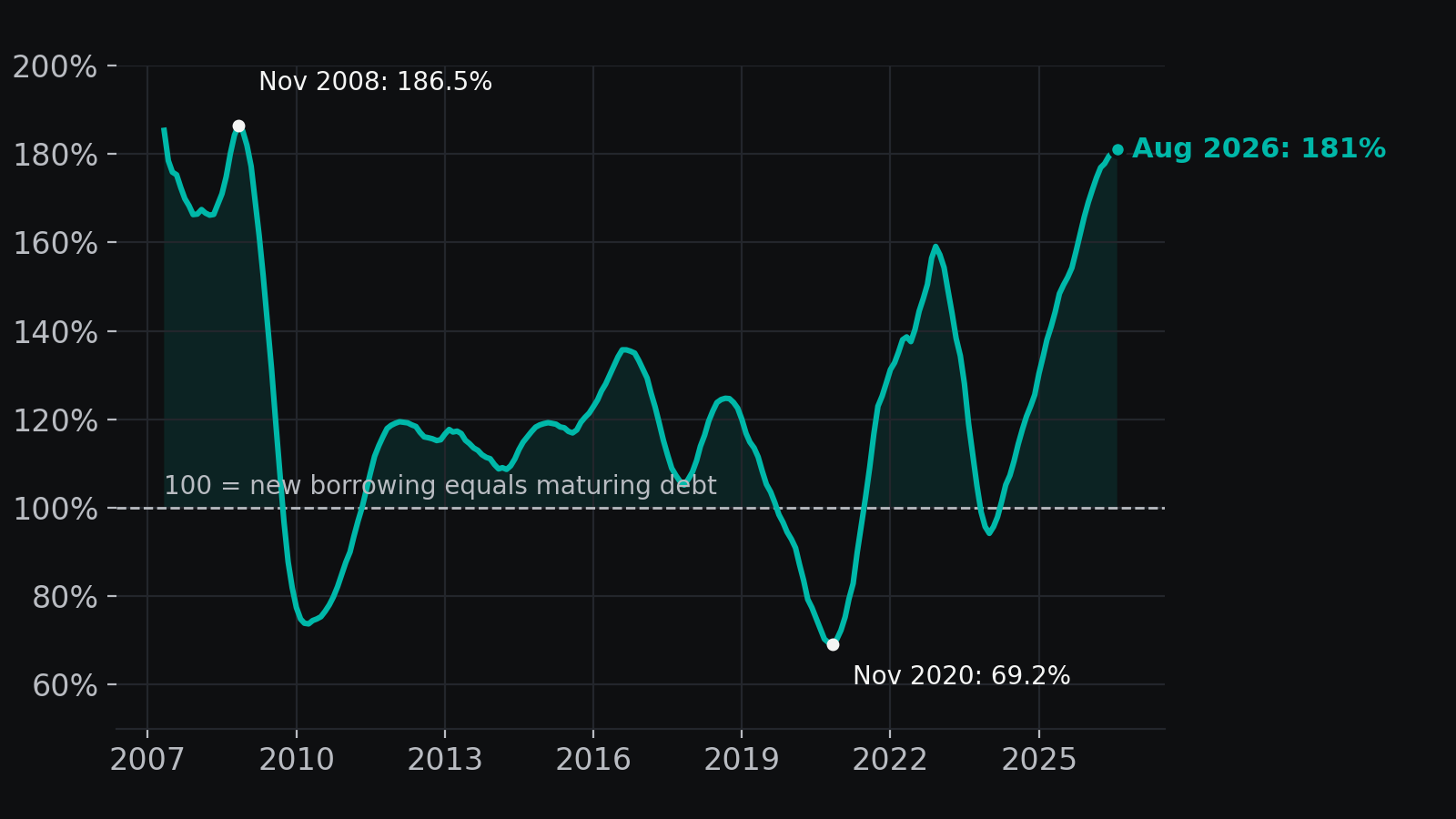
The chart shows the external debt rollover ratio of Turkey's non-bank companies (12-month average). 100 means borrowing exactly as much as falls due. Above 100, companies are raising net new money abroad.
- In November 2020 the ratio fell to 69%: companies could not roll their debt and were paying it down.
- A year ago it was 152%. In August 2026 it was 181%.
- The climb has slowed in recent months but has not stopped: +3 points since May.
Why so fast? The rate gap
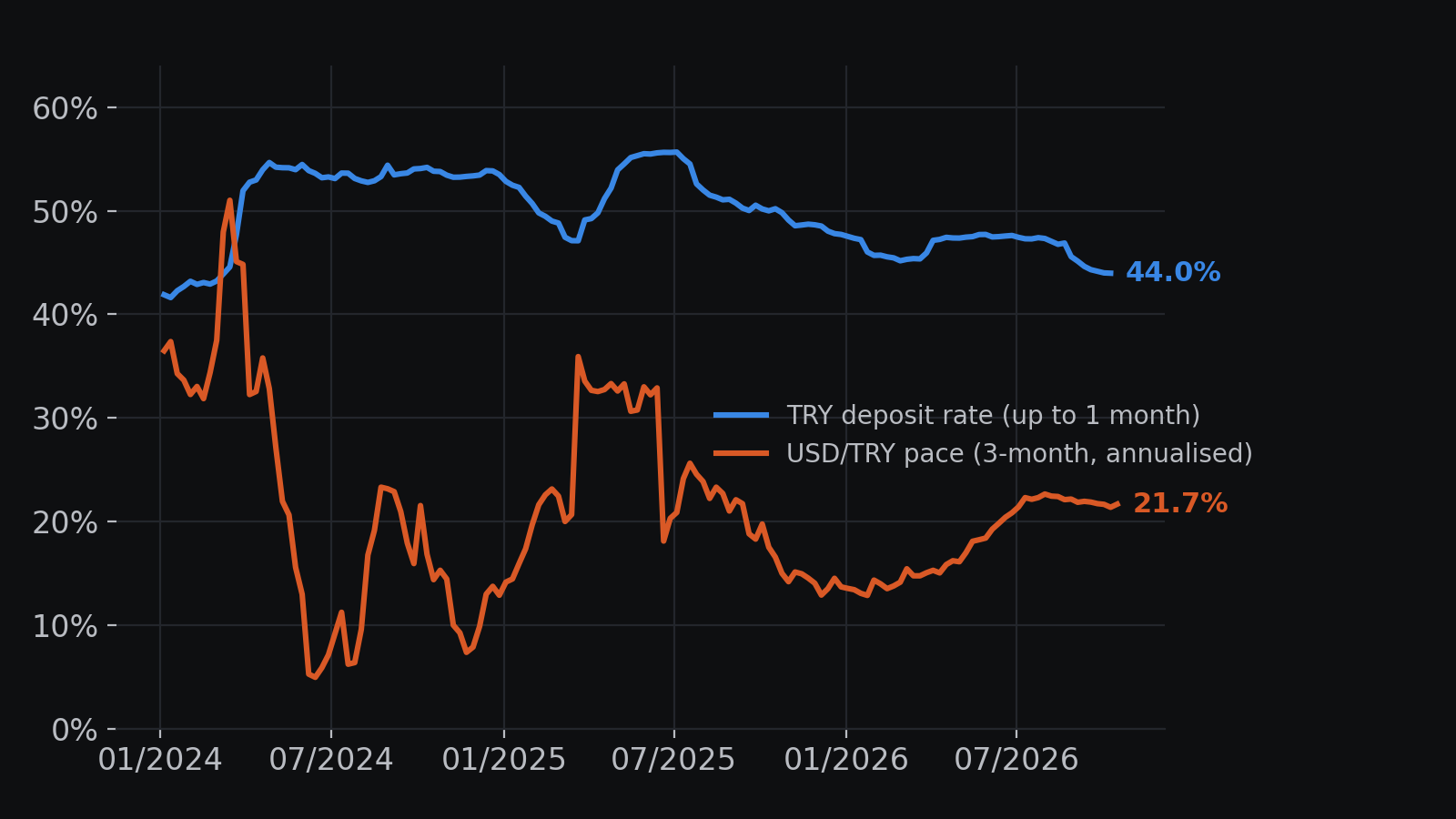
A lira deposit of up to one month pays 44% (gross, week of 9 October). The dollar, meanwhile, is rising against the lira at about 22% a year at the pace of the last three months. That 22-point gap makes borrowing in dollars and operating in lira look cheap, and companies are using it.
The one thing the sum depends on
External debt due within a year (by remaining maturity; all of Turkey: government, central bank, banks and companies) reached $248.1bn in July 2026, the highest since the series began in 2011. A year earlier it was $223.3bn.
Foreign-currency borrowing only looks cheap while the lira keeps weakening at today's pace. If that pace picks up, or funding abroad gets tighter, the same arithmetic runs in reverse. There is a precedent: after the 2008 peak, the 12-month ratio fell from 186% to 82% in 13 months.
Three things we are watching
- The rollover ratio: September data is due around mid-November.
- The monthly pace of the lira: one of the dated projections below is about it.
- The 22 October rate decision: it steers the deposit rate, one side of the gap.
Data: CBRT EVDS (TP.ODEROLL.K4, TP.KALANVADE.K20, TP.TRYTAS.MT01), CBRT indicative exchange rate; as of 15 October 2026. The lira's pace is an InvestMuse calculation: the change in USD/TRY over three months, annualised.
Projections
Dated, checkable projections about macro conditions — not forecasts of asset prices. Each one is checked in public on its stated date and its outcome is updated here.
- OpenP-0001-1Made 15 October 2026Check 23 October 2026
Turkey's October 2026 consumer confidence index (TÜİK) prints below September's 91.92.
- OpenP-0001-2Made 15 October 2026Check 22 October 2026
At the 22 Oct 2026 MPC meeting the CBRT does not cut the policy rate by more than 100bp (rate stays at or above 36%).
- OpenP-0001-3Made 15 October 2026Check 5 January 2027
The CBRT USD buying rate rises less than 2% month on month in each of October, November and December 2026.
Data fingerprint: sha256:002fc38f3d29d539 · data as of 2026-10-15 · 247 series
This series reads macro conditions. It does not forecast the return of any asset, and nothing in it is a call to trade.
DATA JOURNALISM, NOT INVESTMENT ADVICE. InvestMuse provides analytical and backtesting software for informational purposes only. It surfaces patterns in price, fundamentals, news sentiment, and historical analogues across 1,237 assets. No trade execution, no brokerage connectivity, no personalized investment recommendations, no trading signals. We do not issue ratings or targets. All output is educational. Decisions are yours. Past performance does not guarantee future results.