Lula's win gave Brazil's stocks their worst week since 2020, and Mexico barely moved
Brazil's Ibovespa fell 17.1% between 22 and 29 October, its worst week since March 2020, most of it on 26 October, the first session after Lula beat Flávio Bolsonaro in the runoff. Markets had positioned for a Bolsonaro win; the dollar rose 8.3% against the real that day. Mexico's IPC barely moved.
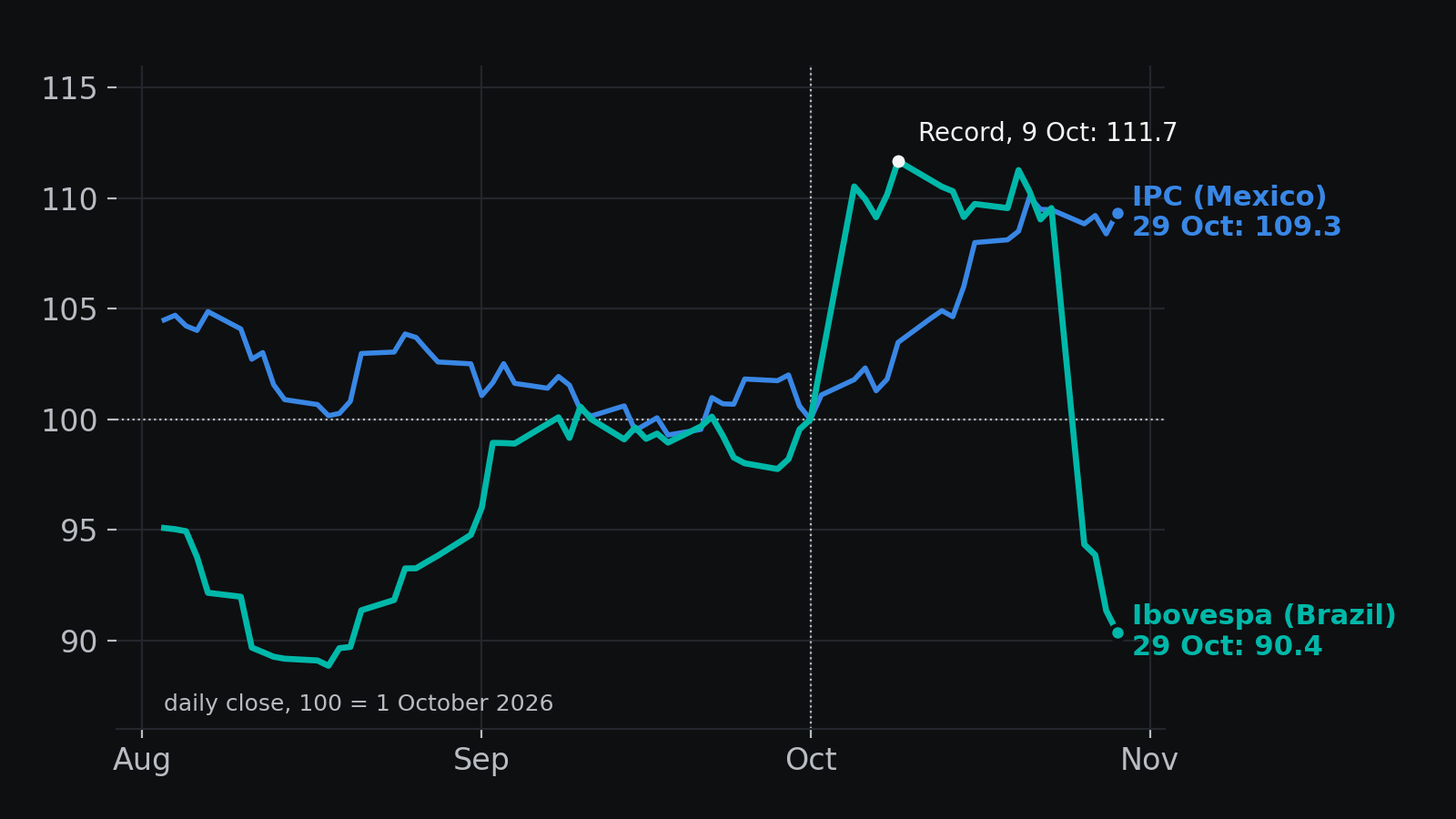
Brazil's main stock index, the Ibovespa, set a record on 9 October (our data begin in 2015). Three weeks later the picture had flipped: between 22 and 29 October the index fell 17.1%, its largest one-week fall since March 2020. On 29 October the Ibovespa closed 19.1% below its record, its lowest close since 20 August.
Most of the fall came in one day
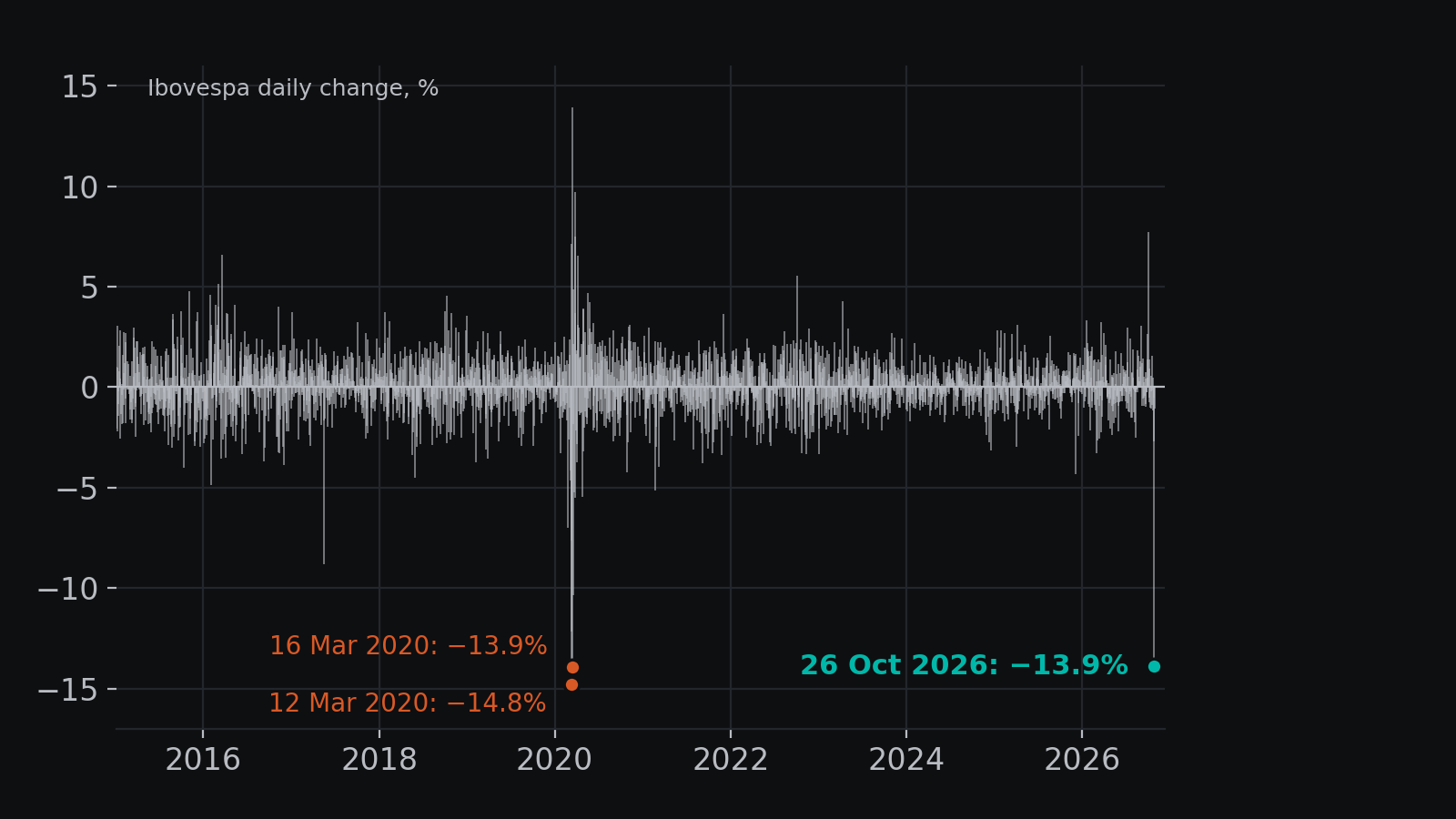
On Monday 26 October the index fell 13.9% in a single session. Since 2015 only two days saw a steeper fall: 12 March 2020 (14.8%) and 16 March 2020 (13.9%).
On the same day the US dollar rose 8.3% against the Brazilian real. That is the largest one-day rise since our data begin in 2015; the previous largest was 7.5% on 18 May 2017.
Markets had bet on the other candidate
That Monday was the first trading day after Brazil's presidential runoff on Sunday 25 October. Luiz Inácio Lula da Silva won a fourth term with about 51.8% of the valid votes, a margin of about 4.4 million votes over Flávio Bolsonaro (The Rio Times). Bolsonaro has not conceded.
Markets had been positioned the other way. After the first round, when Bolsonaro finished ahead of Lula, the Ibovespa rose 7.7% on Monday 5 October and set its record four days later. "Markets were broadly positioned for a Bolsonaro victory," a Julius Baer analyst told MercoPress; investors saw his government as more likely to curb public spending, which they treated as the key to lower interest rates (Trading Economics). The runoff reversed that bet in one session, and the Treasury cancelled the debt auctions planned for 27 to 29 October (MercoPress).
The data also show where the move stopped: it did not spread across Latin America.
Mexico barely moved
Mexico's IPC index and the Ibovespa usually move together; this time they split. From 1 to 29 October the Ibovespa fell 9.6% while the IPC rose 9.3%, and in Brazil's worst week the IPC slipped only 0.1%. When one index falls as hard in a day as it did in March 2020 while its neighbour barely moves, the data point to a move specific to Brazil: an election shock, not a regional wave.
Our AlgoTrader felt it too
The InvestMuse HMM AlgoTrader had bought two Brazilian names at the 6 October open, the morning after the first-round rally: XP Inc. and Bradesco (NYSE: BBD). It sold both at the 26 October open, XP at −50.3% and Bradesco at −33.6% (play money). XP had jumped 30.9% on 5 October; after the runoff it gave all of that back and more.
Three things we are watching
- Who Lula names to his economic team, and when the Treasury reschedules the cancelled debt auctions.
- Brazil's Selic policy rate: 13.75% since 17 September (14.00% before).
- The Macro Weather reading for the week ending 30 October: the interim reading is 0.39, inside the Calm band.
Data: Yahoo (^BVSP, ^MXX, BRL=X, MXN=X), Central Bank of Brazil (SGS 432), InvestMuse GeoPulse Macro Weather, InvestMuse HMM AlgoTrader trade log; as of 30 October 2026. Election result and market reports: The Rio Times (30 October), MercoPress (26 October), Trading Economics. Index data are 29 October closes, currency data 28 October; daily changes are an InvestMuse calculation on daily closes since 2015.
Data fingerprint: sha256:3619270b958e11c4 · data as of 2026-10-30 · 247 series
This series reads macro conditions. It does not forecast the return of any asset, and nothing in it is a call to trade.
DATA JOURNALISM, NOT INVESTMENT ADVICE. InvestMuse provides analytical and backtesting software for informational purposes only. It surfaces patterns in price, fundamentals, news sentiment, and historical analogues across 1,279 assets. No trade execution, no brokerage connectivity, no personalized investment recommendations, no trading signals. We do not issue ratings or targets. All output is educational. Decisions are yours. Past performance does not guarantee future results.