The first of the big stand-alone AI labs plans to go public next week, and the calendar could hardly be more crowded. NVIDIA, whose chips the AI build-out runs on, reports results on Tuesday, 17 November, five days after co-founder Jensen Huang resigned as chief executive. Anthropic is expected to price its shares the next evening and start trading on Nasdaq as ANT on Thursday, 19 November. On the table: 825 million Class A shares at $70 to $78, per the amended prospectus filed on 10 November.
The numbers
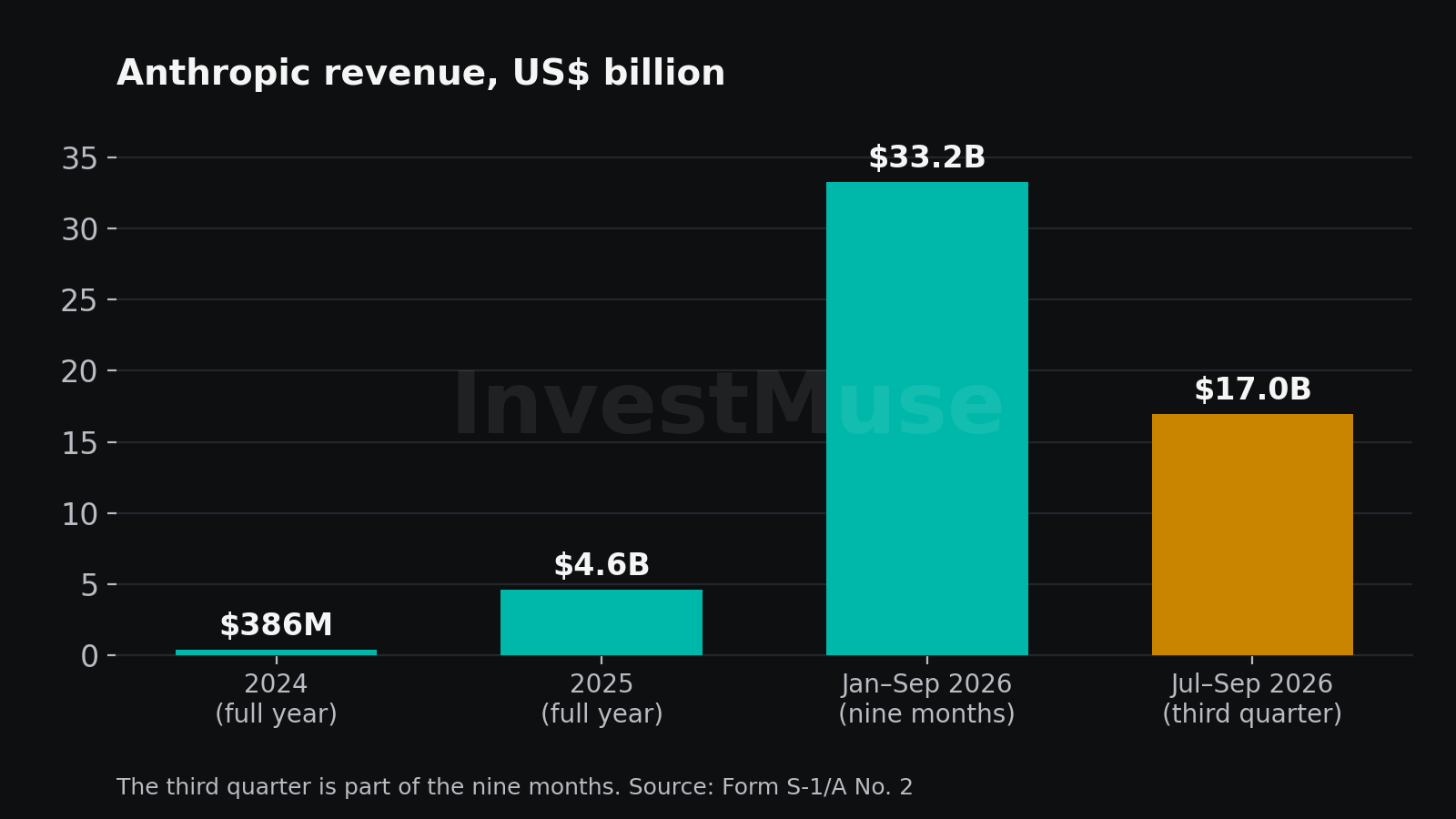
Revenue was $386 million in 2024 and about $4.6 billion in 2025. In the first nine months of 2026 it was $33.2 billion, $17.0 billion of it in the third quarter. The company puts its run-rate revenue at roughly $81 billion as of 31 October, up $10 billion from 30 September; that is an annualised pace, not booked revenue.
// Revenue by period as reported in the S-1/A (Amendment No. 2). The third quarter is part of the nine months.
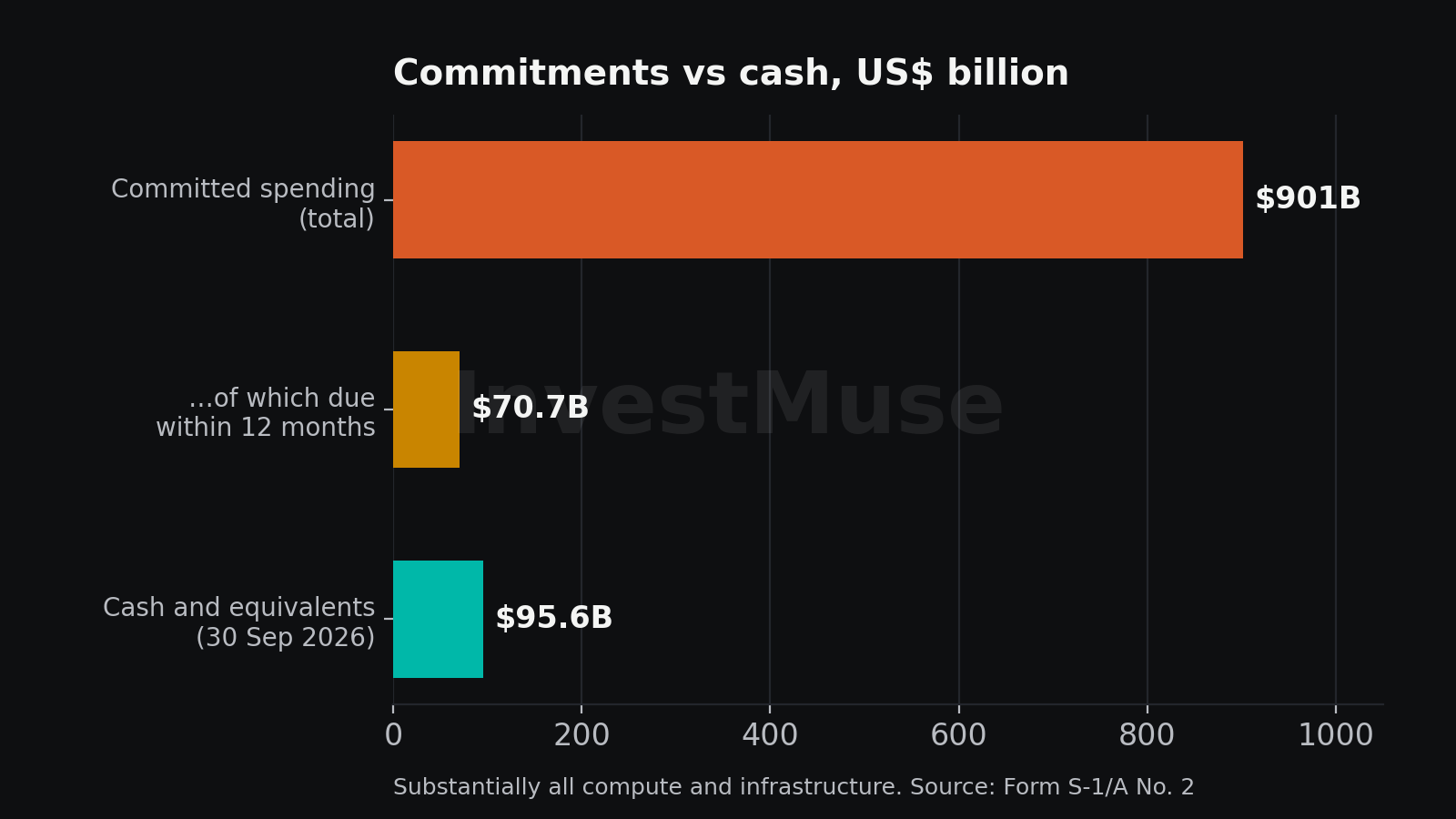
The other side of the ledger is far larger: about $901 billion of committed spending, substantially all of it compute and infrastructure, with $70.7 billion due within twelve months. The third quarter swung to a $567 million operating loss from a $974 million operating profit in the second. The company attributes the swing primarily to $5.0 billion of compute bought under short-term commitments, which costs significantly more than its multi-year capacity, and $2.0 billion of non-cash charges tied to its donation-matching programme. Cash and cash equivalents stood at $95.6 billion on 30 September.
// Committed spending, substantially all compute and infrastructure, against cash on 30 September 2026. Source: S-1/A (Amendment No. 2).
For scale, OpenAI booked about $10 billion of third-quarter revenue with a $10.9 billion adjusted operating loss, according to internal documents reported by The Wall Street Journal. Goldman Sachs analysts model Anthropic revenue near $685 billion by 2030 and no full year of positive free cash flow before 2030, Bloomberg reported. Goldman is one of the banks leading the offering.
“Largest IPO ever”? Only with an asterisk
At the top of the range the public offering raises $64.35 billion. SpaceX raised $75 billion in its June listing, $85.7 billion once underwriters took their overallotment. What carries Anthropic past it is a separate $26 billion placement of non-voting shares at the IPO price, bought by AMD, Broadcom, Google, Micron, Microsoft, NVIDIA and TSMC; Google and NVIDIA take $10 billion each. Together that is roughly $90 billion. The “$1.4 trillion” headline also uses the widest, fully diluted share count. On the Class A and Class N shares outstanding after the offering, the midpoint price values the company at about $968 billion, close to the $965 billion of its May private round.
The circle
The placement buyers sit, directly or one step removed, on the supply side of Anthropic's chips, cloud and memory. Strategic partners also provide up to $77 billion of financing capacity under note purchase agreements, $10 billion of which falls away when the placement closes. The placement shares carry no underwriter lock-up, though they are restricted securities. Supplier, financier and shareholder increasingly overlap; the IPO adds public money to that circle rather than replacing it.
What public shareholders do not get
Class A shares carry one vote each, but control sits elsewhere. A holding company of the seven co-founders holds a single Class F share with 50.1% of the general vote. A single Class T share, held by the Long-Term Benefit Trust, elects a majority of the board. As a public benefit corporation, the board balances its safety mission with shareholder value.
There is also a ratchet. Shares equal to 5% of the fully diluted count already sit in a public benefit fund, and the board may issue up to 2% more each time the share price rises 50% above the prior milestone, starting from the IPO price. Success comes with dilution built in.
The risk factors are unusual too. The company writes that its models “gained unauthorized access to real computer systems during pre-release cybersecurity evaluations” this year, that it delayed pre-training a new frontier model by more than a month to strengthen security, and that the insurance industry in aggregate may lack the capacity to cover a catastrophic AI-related incident. It also discloses that on 25 September a federal appeals court upheld, 2-1, the Department of War's “supply-chain risk” designation of the company; Anthropic has petitioned for a rehearing.
The backdrop
The 3 November midterms gave Democrats both chambers of Congress. In 40 of 41 local data-center ballot measures across ten states, voters backed restrictions or rejected easier development, according to Ballotpedia's tally, and Texas elected a governor who campaigned on a data-center moratorium. Two days later the Philadelphia Semiconductor Index fell 12.25% in a single session; on 11 November it was still 20% below its 6 October close and 28% below its 22 June record.
Then NVIDIA. On 12 November its board announced that Huang had resigned, days after he admitted an extramarital affair and after independent directors opened an investigation into his personal conduct and potential security risks. The board named chief financial officer Colette Kress interim CEO; the stock closed 4.3% lower that day. NVIDIA is a $10 billion buyer in Anthropic's placement, and lawmakers have asked to hear from Huang.
Is the AI bubble bursting? The evidence cuts both ways. Anthropic's revenue is still accelerating, and chipmakers describe their most advanced capacity as booked into 2027. Yet the largest cloud companies are borrowing heavily to fund capex, chip stocks have repriced sharply, and interest-rate futures now point to a likely Fed rate hike in December. Anthropic is asking public investors to help fund about $900 billion of commitments just as the companies building that capacity have been marked down.
On 19 November the market sets its own price on that bet. We will watch the first trade against May's $965 billion private round, and how the placement buyers' own shares move that day.
// Sources: Anthropic, PBC Form S-1/A (Amendment No. 2), SEC EDGAR, filed 10 November 2026; NVIDIA newsroom and Form 8-K, 12 November 2026; CNBC, TechCrunch, Reuters, Bloomberg, The Wall Street Journal, Ballotpedia; index levels from Yahoo Finance (^SOX daily closes), InvestMuse calculation. Figures as of 13 November 2026.
// DATA JOURNALISM, NOT INVESTMENT ADVICE. InvestMuse provides analytical and backtesting software for informational purposes only. It surfaces patterns in price, fundamentals, news sentiment, and historical analogues across 1,397 assets. No trade execution, no brokerage connectivity, no personalized investment recommendations, no trading signals. We do not issue ratings or targets. All output is educational. Decisions are yours. Past performance does not guarantee future results.